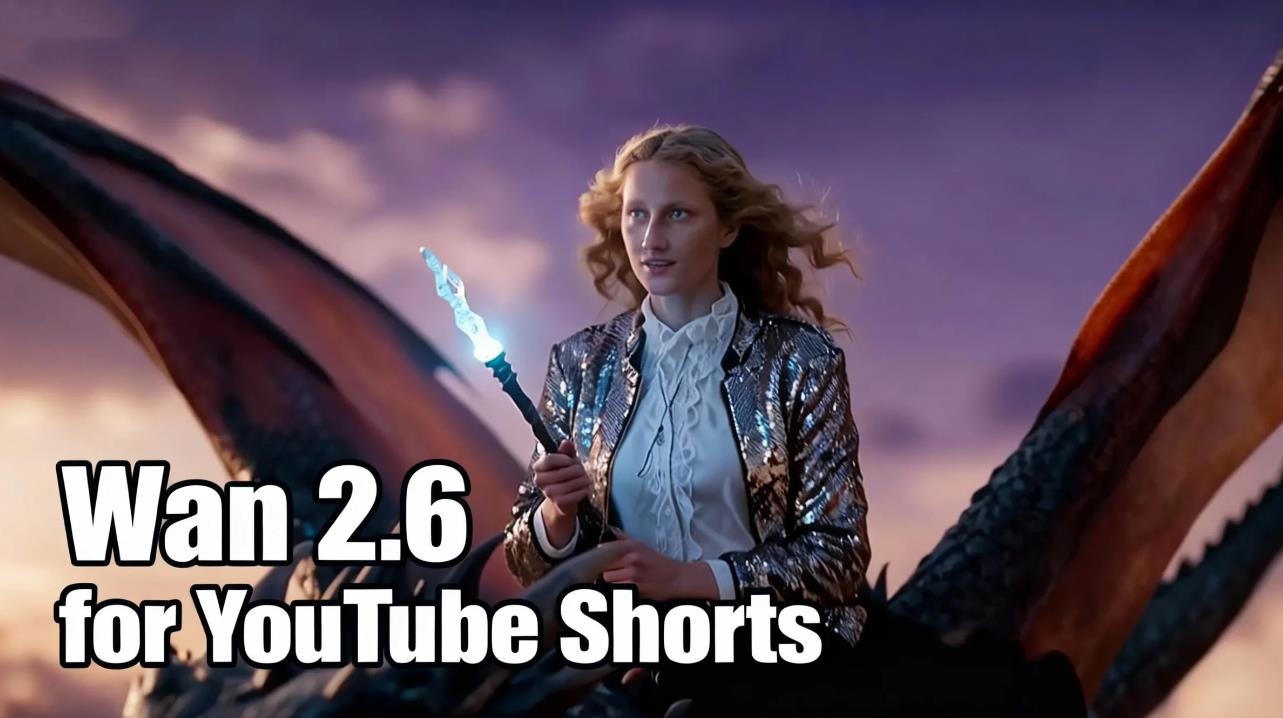
YouTube Shorts has reshaped short-form economics. Compared to traditional production—camera, editing, voiceover, and hours per video—Wan 2.6 for YouTube Shorts offers a faster path from script to vertical video, which is why many creators are experimenting with automation workflows for faceless channels and niche explainers.
This guide breaks down a practical creator workflow: how to choose niches, write retention-first scripts, generate vertical videos with Wan 2.6 for YouTube Shorts, and publish consistently—while also covering realistic limitations, cost math, and how it compares to other popular generators.
Try Wan 2.6 for YouTube Shorts
Why YouTube Shorts Matter for Creators in 2026
Shorts distribution is driven by a discovery-style recommendation pool rather than subscriptions. That means a new channel can still get meaningful reach if videos earn strong retention and rewatch behavior.
Three reasons Shorts fit automation workflows (for many creators):
High frequency is rewarded: consistent posting matters more than “perfect” production.
Loop mechanics boost watch time: endings that flow into openings often increase replays.
Vertical-first viewing: mobile composition, pacing, and audio clarity are critical.
Used thoughtfully, Wan 2.6 for YouTube Shorts can reduce the time and complexity required to keep up with that frequency.
What Wan 2.6 Adds to a Shorts Workflow
Native audio-video synchronization
Many AI tools generate visuals first and treat voice as a separate step. Wan 2.6 for YouTube Shorts can generate audio and video together, which helps with timing, mouth movement, and overall pacing—important when retention drops quickly if narration feels “off.”
Vertical 9:16 composition
Instead of generating 16:9 and cropping, Wan 2.6 for YouTube Shorts supports vertical framing more directly. For creators who publish primarily on Shorts, this reduces reformat work and helps keep compositions readable around UI overlays.
Character identity consistency (image-guided)
If you run a faceless channel with a recurring host character, consistency matters. Wan 2.6 supports image-guided generation so a reference image can anchor facial structure and styling across many uploads.
Single-pass generation
A simpler pipeline is easier to scale. Many creators use a script → generation → captions → upload loop, and Wan 2.6 for YouTube Shorts fits into that pattern.
A Realistic Automation Workflow (End-to-End)
Step 1: Pick a niche that benefits from repetition
Good fits for Wan 2.6 for YouTube Shorts are niches where repeated structure improves performance:
Motivation / mindset
AI & tech facts
Business tips / productivity
Storytime micro-narratives
Simple educational explainers
Anime-style mini scenes
Tip: choose one niche and stay consistent for 2–4 weeks. Shorts algorithms often respond better to stable topic signals.
Step 2: Write scripts optimized for retention (20–35 seconds)
A common high-retention pattern:
Hook (0–2s): “Most people misunderstand this…”
Payoff (2–25s): clear, specific steps or facts
Loop ending (last 3–5s): connect back to the hook or tease a follow-up
For Wan 2.6 for YouTube Shorts, keep language simple, avoid long compound sentences, and include short pauses for visual beats.
Step 3: Prepare a character reference (optional)
If you want a consistent “host,” use one clean reference image:
clear face, neutral expression
simple background
good lighting
1024×1024 or higher
Step 4: Generate with the tool
Go to: https://www.wan-ai.co/wan-2-6
A practical prompt format (works well for many creators):
Vertical 9:16 YouTube Short. Narration: [paste script] Style: cinematic lighting, smooth camera motion, clean composition. Audio: native audio-video sync, clear pacing. Ending: loop-friendly final shot similar to opening frame.
Step 5: Add captions and publish consistently
YouTube auto-captions can be enough to start. Many creators later move to stylized captions for higher retention, but consistency beats over-optimization early.
Step 6: Batch production (weekly cadence)
A typical batch approach:
write 10 scripts (60–90 minutes)
generate 10 videos (queue-based)
caption + schedule uploads
This is where Wan 2.6 for YouTube Shorts can feel most useful: it turns daily posting into a weekly routine.
Prompt Templates (Copy-Paste)
Motivation
Vertical 9:16. Calm confident narrator. Cinematic warm lighting, subtle camera push, clean background. Native audio-video sync. Loop ending that returns to the opening frame. Script: [paste]
AI/Tech Fact
Vertical 9:16 explainer with friendly presenter. Modern clean background, simple visual metaphors. Clear narration, native sync, surprising hook, tight pacing. Script: [paste]
Storytime
Vertical 9:16 micro-story, character-driven emotion. Expressive face, mood lighting, smooth transitions. Native synchronized dialogue. Ending teases the beginning for replay. Script: [paste]
Detailed Comparison Table (Shorts Use Case)
Feature (Shorts-focused) | Wan 2.6 | Sora | Veo |
|---|---|---|---|
Native vertical 9:16 workflow | ✅ Strong | ⚠️ Varies | ⚠️ Varies |
Native audio-video sync | ✅ Yes | ⚠️ Depends on access/mode | ⚠️ Depends on workflow |
Character consistency (image-guided) | ✅ Strong | ⚠️ Variable | ⚠️ Variable |
Batch-friendly workflow | ✅ Practical | ⚠️ Varies | ⚠️ Varies |
Best at | Narration + consistent host | Visual imagination | Cinematic visuals |
Typical friction points | Prompt tuning | Access/cost | Access/cost |
Note: capabilities vary by plan/version and your specific workflow. Use the table as a workflow comparison, not a universal ranking.
Cost Analysis (Sample Numbers)
Below is a simple 10-Shorts comparison for a solo creator. Numbers vary widely, but the pattern is consistent.
Traditional (filming + editing)
Time: 15–25 hours (script, filming, edit, captions, exports)
Hard cost: $0–$300+ (if you already have gear; otherwise more)
Ongoing: your time is the main cost
Outsourced (editor + voiceover)
Per Short: $50–$150 (common ranges)
10 Shorts: $500–$1,500
Time: 3–6 hours (briefing, revisions)
AI-assisted with Wan 2.6 (automation-style)
Generation spend: varies by plan/credits
Time: 4–7 hours for 10 Shorts (scripts + generation + captions + scheduling)
For many creators, the biggest “savings” is not just dollars—it’s turning daily production into a manageable weekly batch.
Limitations and What to Expect
Wan 2.6 for YouTube Shorts is strong for narration-led, single-host content, but it’s not perfect. Common constraints:
Fast action / extreme motion can introduce blur or instability.
Complex two-person interactions may produce odd hand/gesture artifacts.
Brand-accurate products/logos are inconsistent unless you design around them.
Longer durations can reduce visual stability; Shorts-length is typically safer.
Creators often get better results by leaning into:
single-character presenter formats
clear narration
simple backgrounds
restrained camera motion
short, punchy scripts
Case Data (Typical Ranges)
Performance depends heavily on niche, hook quality, and posting consistency. Still, creators using automation workflows often report ranges like:
New channel (first 60–90 days, consistent posting)
Avg views/Short: 2k–10k
Subscriber growth: 50–300/month
Breakout outliers: occasional spikes beyond 50k views
Established channel (6+ months, refined hooks)
Avg views/Short: 10k–50k
Subscriber growth: 300–1,500/month
Revenue varies by niche and monetization mix
Treat these as directional benchmarks, not guarantees. In most cases, script quality and retention structure matter more than any single tool.
FAQ (6 Questions)
1) How long does it take to make one Short?
Many creators can go from script to a usable video in minutes to under an hour, depending on iteration needs, captions, and scheduling.
2) Do I need editing skills?
Basic trimming and captions help, but you can start with minimal editing. Over time, creators usually add better captions and tighter pacing.
3) What niches work best with this workflow?
Narration-led niches like tech facts, business tips, motivation, and storytime often fit well—especially when a consistent host character improves branding.
4) Can I keep one character consistent across 100+ Shorts?
Using a strong reference image and consistent prompting helps a lot. It’s not perfect, but for many creators it’s workable for serialized channels.
5) How do I improve retention fast?
Tight hooks, faster pacing, fewer filler lines, stronger loop endings, and captions usually beat “more effects.”
6) Is this suitable for monetized channels?
That depends on your licensing terms, platform policies, and your content originality. Many creators use AI-assisted workflows, but always ensure your channel complies with YouTube policies and your tool’s commercial terms.
Conclusion
If you want to post consistently on Shorts, Wan 2.6 for YouTube Shorts can be a practical part of an automation workflow—especially for narration-first videos with a stable host character and vertical-native composition. Compared to traditional production, it can reduce steps and make batch creation easier, but results still depend on scripting, hooks, pacing, and niche strategy.
If you want to test it quickly, start with 10 scripts, generate a batch, post for two weeks, then iterate based on retention graphs.